Prader-Willi Syndrome, Diabetes, Hunger and Behaviour
In early 2026, our son Adam was diagnosed with Type 2 Diabetes.
While the diagnosis itself was confronting, what surprised us most was looking back and realising that diabetes may have been silently developing for weeks or even months before it was discovered.
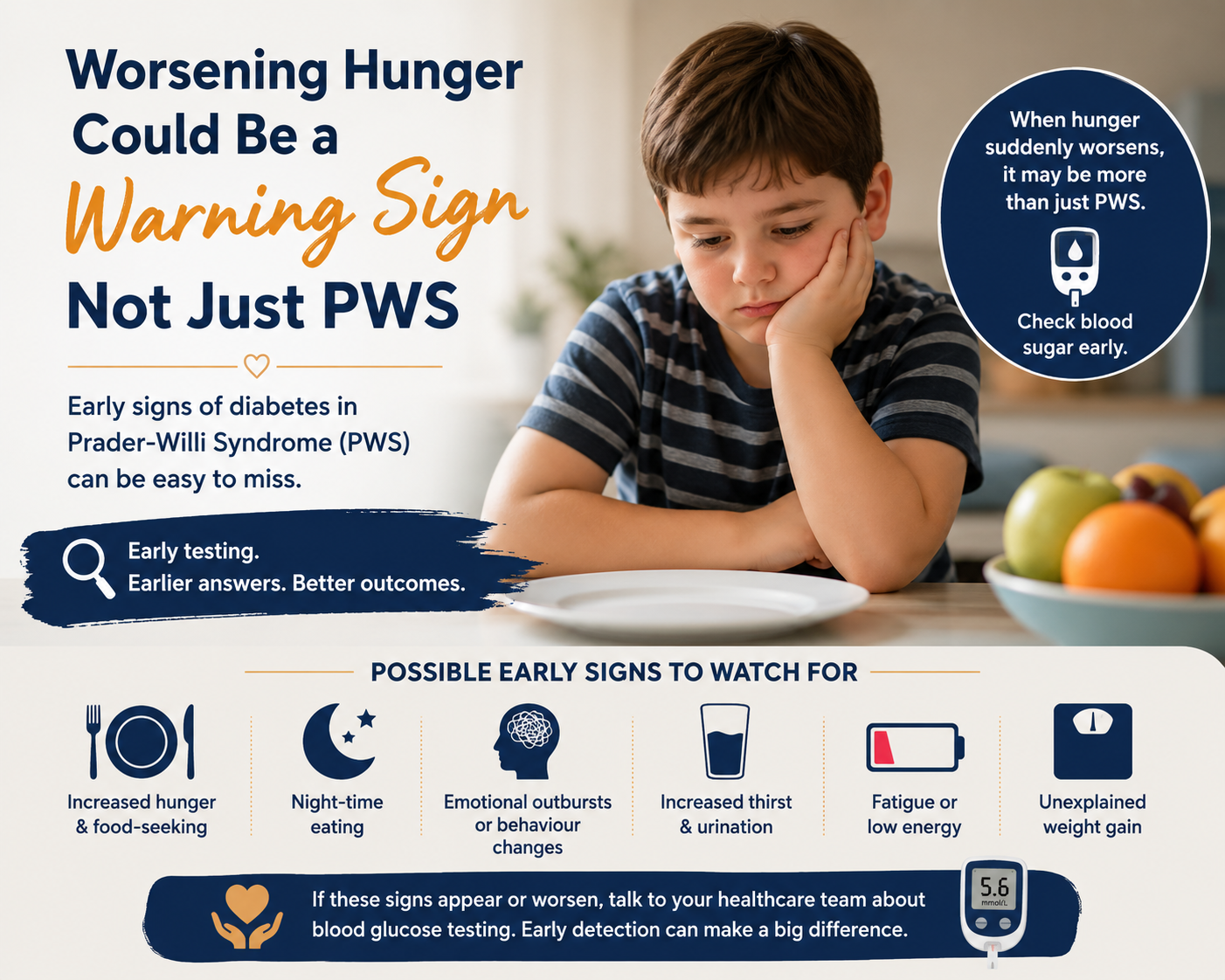
In the months leading up to Adam’s diagnosis, something changed. His hunger became significantly more intense, his food-seeking behaviour escalated, and his emotional regulation deteriorated in ways that were not typical for him.
He began looking for food at night and sometimes in the early hours of the morning. His behaviour became more difficult, not because he was choosing to be difficult, but possibly because his body and brain were under increasing metabolic stress.
This journey has taught us that diabetes in a child with PWS is not simply about blood sugar. It affects hunger, mood, behaviour, sleep, weight, metabolism and quality of life.
Most importantly, it has taught us that worsening hunger and behaviour in PWS should not automatically be assumed to be “just PWS.” Sometimes there may be another medical reason.
Looking Back: The Warning Signs Before Diagnosis
Looking back, we now believe Adam’s diabetes may have been developing before diagnosis.
At the time, we thought many of the changes were part of Prader-Willi Syndrome itself. However, after learning more about diabetes and insulin resistance, we realised there may have been warning signs.
In the weeks and months before diagnosis, Adam’s hunger increased dramatically beyond his usual PWS baseline.
We noticed:
- Constant requests for food.
- Increased food seeking throughout the day.
- Escalating food obsession.
- Waking during the night looking for food.
- Eating in the early hours of the morning.
- Increased frustration when food was restricted.
- More behavioural incidents and emotional outbursts.
- Reduced tolerance for changes in routine.
- Increased irritability and distress.
As parents, we knew PWS hunger was always present. However, this felt different. The intensity had increased significantly.
What we did not realise at the time was that uncontrolled diabetes may have been contributing.
When blood glucose levels are high, the body’s cells cannot effectively use glucose for energy. Even though there is sugar in the bloodstream, the brain and body may still behave as if energy is not being used properly.
This may increase hunger signals and food-seeking behaviour.
For someone already living with PWS, this additional biological drive may make hyperphagia much worse.
Why Early Blood Sugar Testing Matters in PWS
One of the most important lessons from Adam’s experience is the need for earlier diabetes screening.
Worsening food-seeking behaviour is often assumed to be part of PWS. However, our experience suggests that a sudden or significant change from a person’s usual baseline should always prompt medical review.
If a child, teenager or young adult with PWS develops:
- Rapidly increasing hunger.
- New night-time food seeking.
- Increased eating overnight.
- Escalating food obsession.
- Increased thirst.
- Increased urination.
- Unexplained fatigue.
- Sudden weight gain.
- Behavioural deterioration.
- Emotional outbursts that are unusual for them.
Families and clinicians should consider checking blood glucose levels.
Regular diabetes screening may be especially important during adolescence and young adulthood, particularly when obesity or insulin resistance is present.
Useful checks may include:
- HbA1c.
- Fasting blood glucose.
- Random glucose checks when symptoms change.
- Weight and waist monitoring.
- Review of sudden behavioural changes.
Sometimes what appears to be a behavioural problem may actually be a medical problem waiting to be discovered.
Why Diabetes Developed
People with PWS are at higher risk of Type 2 Diabetes because of several overlapping factors:
- Obesity.
- Reduced muscle mass.
- Lower energy expenditure.
- Insulin resistance.
- Reduced physical activity.
- Hormonal differences.
When Adam’s blood glucose began rising, his body was no longer using insulin effectively.
His blood sugar reached levels requiring urgent medical treatment.
Understanding Insulin Treatment
Adam was started on insulin therapy to bring glucose levels under control.
Insulin is an essential and sometimes life-saving medication.
It helps move glucose from the bloodstream into cells.
However, insulin can also create new challenges in PWS.
Why Insulin Can Increase Hunger
Rapid-acting insulin lowers blood glucose after meals.
If glucose falls quickly, the brain may interpret this as an energy drop.
Even if the glucose number is still within the normal range, the speed of the drop can trigger:
- Hunger.
- Food seeking.
- Irritability.
- Emotional distress.
For someone with PWS, this effect may be amplified because hunger signals are already abnormal.
This may explain why some children feel more hungry in the hours after rapid-acting insulin.
Why Insulin Can Cause Weight Gain
Insulin is often described as a storage hormone.
It helps the body store energy.
When insulin levels increase:
- Fat breakdown slows.
- More calories are retained.
- Extra energy can be stored as fat.
- Weight gain becomes easier.
For children with PWS, this can be especially challenging because their metabolism is already lower than typical children.
Why Adam Gains Weight More Easily Than Other Children
One of the most difficult realities of PWS is that weight gain can occur even when food intake seems reasonable.
Several biological factors contribute.
Lower Resting Metabolism
Children with PWS often burn fewer calories at rest.
This means they may need fewer calories than other children of the same age and size.
Reduced Muscle Mass
Muscle burns energy throughout the day.
Lower muscle mass means lower energy use.
Hormonal Differences
Hormonal changes can make fat storage easier and weight loss harder.
Reduced Physical Activity
Low muscle tone, fatigue and reduced stamina can reduce total daily movement.
Together, these factors create a body that stores energy efficiently but burns energy slowly.
The Role of Metformin
Metformin was added to Adam’s treatment plan to improve insulin sensitivity.
Metformin may help by:
- Lowering blood glucose.
- Reducing insulin resistance.
- Reducing glucose release from the liver.
- Reducing the amount of insulin needed over time.
Metformin may slightly reduce appetite in some people.
However, in PWS, the effect on true hyperphagia is usually limited.
For Adam, Metformin is mainly important for diabetes control. Any hunger benefit may be mild and indirect.
GLP-1 Treatment: Diabetes Control, Weight Loss and Hunger in PWS
GLP-1 medicines are increasingly discussed for people with Type 2 Diabetes and obesity.
Examples include:
- Liraglutide.
- Semaglutide.
- Exenatide.
- Other newer medicines in the same family.
These medicines copy the effect of a natural gut hormone called GLP-1.
They may help by:
- Improving blood glucose control.
- Increasing insulin release when glucose is high.
- Reducing glucagon.
- Slowing stomach emptying.
- Increasing fullness.
- Supporting weight loss.
For Adam’s situation, GLP-1 treatment is medically interesting because it may target three important problems at the same time:
- Type 2 Diabetes.
- Obesity.
- Appetite and food drive.
However, the evidence in Prader-Willi Syndrome is still limited and mixed.
Balanced View on GLP-1 for Adam
Based on current evidence, GLP-1 treatment in PWS should be viewed realistically.
It may help:
- Diabetes control.
- Weight loss or weight stabilisation.
- Insulin resistance.
- Possibly reduce insulin dose.
- Possibly reduce hunger slightly.
But it may not reliably fix:
- Severe PWS hyperphagia.
- Food obsession.
- Behaviour driven by food anxiety.
The research is promising but still inconclusive.
For Adam, GLP-1 may be a reasonable specialist discussion because he has both Type 2 Diabetes and obesity. But it must be balanced against constipation, stomach emptying and PWS-specific safety risks.
Managing Constipation in PWS
Constipation is very common in PWS.
Contributing factors include:
- Low muscle tone in the gut.
- Reduced physical activity.
- Low fluid intake.
- Medications.
- Slow digestion.
Maintaining bowel health is essential.
This becomes even more important if considering GLP-1 treatment, because these medicines can worsen nausea, constipation or delayed gastric emptying in some people.
For Adam, bowel monitoring should be part of any diabetes or weight-management plan.
The Relationship Between Hunger and Behaviour
One of the most important lessons we have learned is that behaviour cannot be separated from hunger.
When Adam experiences intense hunger:
- Anxiety increases.
- Frustration rises.
- Emotional regulation becomes more difficult.
- Meltdowns become more likely.
Many behaviours labelled as “challenging behaviour” may actually be expressions of biological distress.
Understanding this has changed how we support Adam.
Instead of seeing behaviour as non-compliance, we increasingly see it as communication.
Hope for the Future
Research into PWS is moving forward.
Families are waiting for treatments that target the root cause of hyperphagia more directly.
At the same time, diabetes and obesity treatments such as GLP-1 medicines may offer useful support for some people with PWS, especially when diabetes is present.
But more research is needed.
Families need clear evidence, careful monitoring and specialist guidance.
Adam’s Journey Continues
Living with Prader-Willi Syndrome and Type 2 Diabetes is challenging.
There are difficult days, emotional days and exhausting days.
Yet Adam continues to show resilience, humour, kindness and determination.
Our goal is not simply to control blood glucose or reduce weight.
Our goal is to help Adam live a healthy, fulfilling and meaningful life while respecting the unique challenges that PWS presents.
If Adam’s story helps even one family recognise the warning signs of diabetes earlier, then sharing our journey will have been worthwhile.
Sometimes worsening hunger and behaviour are not simply symptoms of PWS.
Sometimes they are the body’s way of telling us something else is happening.
Listening to those changes may make all the difference.