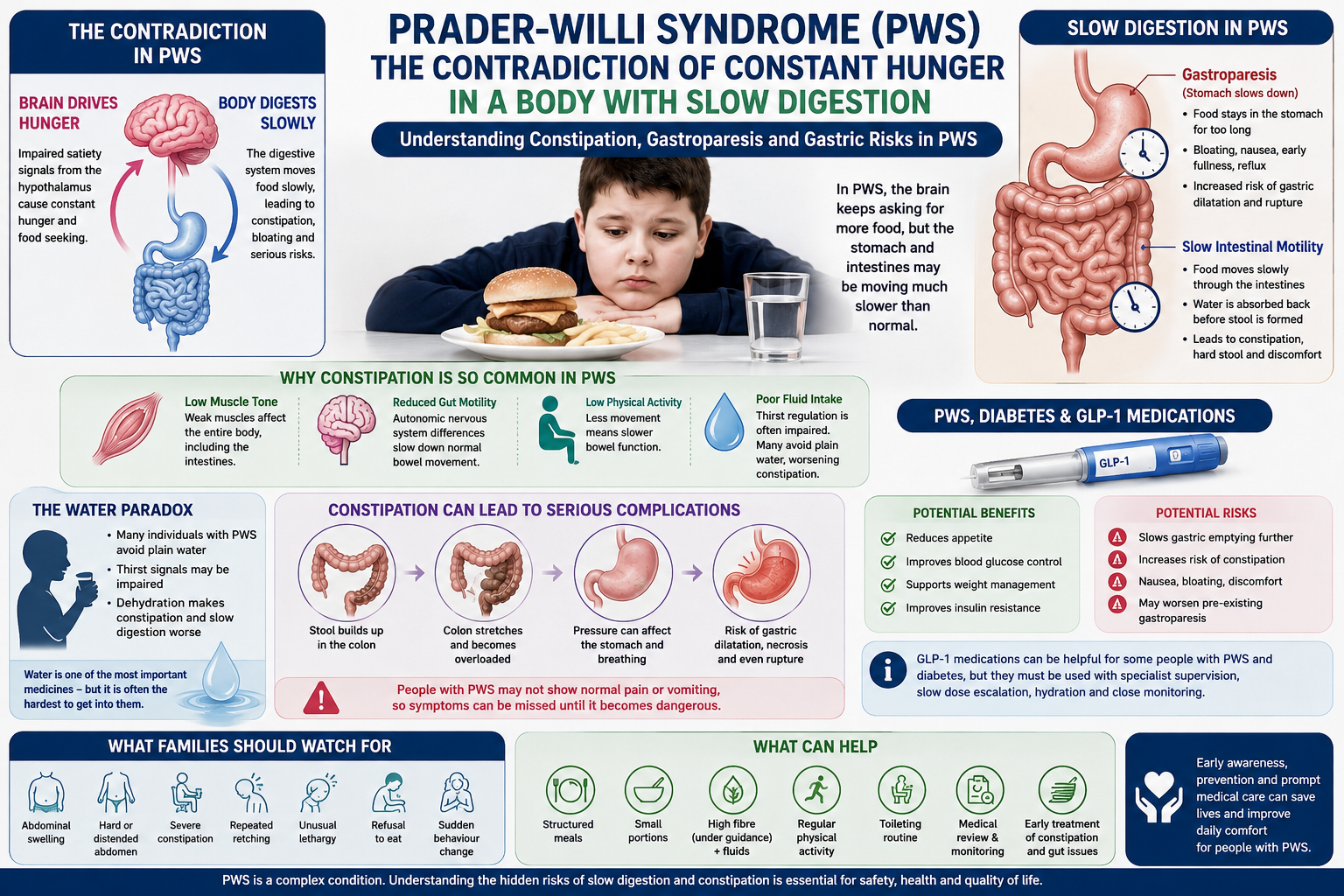
The Great Contradiction of Prader-Willi Syndrome: Constant Hunger in a Body Designed for Slow Digestion
Prader-Willi Syndrome (PWS) is often described as a condition of insatiable hunger. Families are familiar with the constant food seeking, preoccupation with meals, food-related anxiety, and inability to feel satisfied after eating.
However, one of the least understood and most dangerous aspects of PWS is that the digestive system often functions in the exact opposite way.
While the brain is continuously demanding more food, the stomach and intestines may be moving food significantly slower than normal.
This creates one of the greatest biological contradictions in medicine: a person who constantly wants to eat, yet whose digestive system may struggle to process the food already consumed.
The Hypothalamus: The Root of the Problem
PWS is caused by the loss of function of specific genes on chromosome 15 and is widely considered a disorder of hypothalamic dysfunction.
The hypothalamus regulates:
- Hunger
- Satiety (feeling full)
- Body temperature
- Hormones
- Sleep
- Thirst
- Autonomic nervous system functions
In most people, the brain receives signals from the stomach and intestines that enough food has been eaten.
In PWS, these satiety signals are impaired. The result is hyperphagia—a persistent biological drive to eat. Studies have shown that individuals with PWS often have elevated levels of the hunger hormone ghrelin, contributing to chronic food seeking behaviour.
The Other Side of the Story: Slow Gastrointestinal Motility
While hunger signals are accelerated, gut movement is often slowed.
Research has demonstrated that constipation is extremely common in PWS and that many individuals have prolonged gastrointestinal transit times, meaning food moves through the digestive tract more slowly than expected.
This slow movement can affect:
- The stomach
- Small intestine
- Colon
- Rectum
The result can be:
- Chronic constipation
- Bloating
- Abdominal discomfort
- Delayed gastric emptying
- Gastroparesis
- Increased risk of gastric dilatation
Gastroparesis: When the Stomach Becomes Too Slow
Gastroparesis literally means "stomach paralysis" or delayed stomach emptying.
Food remains in the stomach longer than normal because stomach muscles and nerve pathways are not working efficiently.
Research has shown delayed gastric emptying in many individuals with PWS, and experts believe this contributes to the increased risk of gastric dilatation and gastric rupture seen in the syndrome.
Symptoms may include:
- Early fullness
- Abdominal swelling
- Nausea
- Bloating
- Constipation
- Reflux
- Poor appetite during episodes
Ironically, many people with PWS continue to feel hungry despite food remaining in the stomach for prolonged periods.
This means the brain may continue requesting food while the stomach has not yet emptied the previous meal.
Why Constipation Is So Common in PWS
Several mechanisms contribute to constipation:
1. Low Muscle Tone
Hypotonia is present throughout the body in PWS.
The same low muscle tone affecting arms and legs also affects the digestive tract.
Reduced muscle strength within the intestines means food and stool move more slowly.
2. Reduced Gut Motility
The autonomic nervous system controls involuntary functions such as bowel contractions.
Because autonomic regulation is abnormal in PWS, normal intestinal movement may be impaired.
3. Reduced Physical Activity
Lower muscle tone and reduced energy expenditure often result in less physical activity, which further slows bowel function.
4. Inadequate Fluid Intake
Many families observe another paradox in PWS:
The person constantly seeks food but often avoids plain water.
The Water Paradox in PWS
Water is one of the most important tools for preventing constipation.
Yet many individuals with PWS struggle to drink adequate amounts.
Families frequently report:
- Refusal of plain water
- Preference for flavoured drinks
- Poor thirst recognition
- Drinking only when prompted
While scientific understanding is still evolving, hypothalamic dysfunction likely affects thirst regulation just as it affects hunger regulation.
The result is a perfect storm:
- Slow bowel movement
- Poor fluid intake
- Constant food intake
- Increased stool retention
Over time this can lead to severe constipation and bowel dysfunction.
When Hunger Meets Slow Digestion
To understand the contradiction of PWS, imagine a traffic jam.
Food enters the digestive system continuously because the brain is demanding more food.
However, the digestive "highway" is moving slowly.
More cars continue entering the road while the existing traffic cannot clear efficiently.
Eventually the system becomes congested.
This is exactly what can occur in PWS.
The mismatch between excessive food drive and reduced digestive motility may contribute to:
- Constipation
- Gastroparesis
- Gastric dilatation
- Bowel obstruction
- Abdominal pain
- Reflux
Type 2 Diabetes Adds Another Layer of Complexity
Many adolescents and adults with PWS develop Type 2 Diabetes due to obesity and insulin resistance.
Managing diabetes introduces additional challenges.
Dietary restrictions become necessary.
Hydration becomes more important.
Blood glucose control must be balanced against appetite management.
Unfortunately, some diabetes medications can affect gastrointestinal function.
GLP-1 Medications: A Double-Edged Sword
Medications such as:
- Ozempic (semaglutide)
- Wegovy (semaglutide)
- Mounjaro (tirzepatide)
have generated significant interest within the PWS community.
Potential benefits include:
- Reduced appetite
- Improved blood glucose control
- Weight loss
- Improved insulin resistance
These effects can be particularly attractive in PWS.
However, GLP-1 medications intentionally slow gastric emptying as part of their mechanism of action.
In the general population this contributes to feeling full longer.
In PWS, where delayed gastric emptying may already exist, this raises important concerns. Research and expert reviews have specifically cautioned about delayed gastric emptying and the pre-existing risk of gastric rupture in individuals with PWS.
Common gastrointestinal side effects include:
- Constipation
- Nausea
- Bloating
- Delayed stomach emptying
- Abdominal discomfort
For some individuals these side effects are mild.
For others, particularly those with pre-existing constipation or suspected gastroparesis, symptoms can become significant.
This does not mean GLP-1 medications should never be used in PWS. Rather, it highlights the importance of careful specialist supervision, slow dose escalation, hydration monitoring, and proactive constipation management.
The Hidden Danger: Gastric Dilatation
One of the most feared complications in PWS is acute gastric dilatation.
The stomach becomes massively enlarged with food, fluid, or gas.
The stomach wall can lose blood supply, leading to tissue death (gastric necrosis) and, in severe cases, rupture. These events have been repeatedly reported in PWS and can be fatal.
Particularly concerning is that people with PWS often:
- Have a high pain threshold
- May not complain of severe pain
- May not vomit normally
As a result, symptoms may be recognised later than in the general population.
What Families Should Watch For
Seek urgent medical review if a person with PWS develops:
- Sudden abdominal swelling
- Hard or distended abdomen
- Severe constipation
- Repeated retching
- Unusual lethargy
- Refusal to eat
- Breathing difficulty
- Sudden behavioural change
These symptoms should never be dismissed as "just constipation."
Final Thoughts
Prader-Willi Syndrome presents one of the most remarkable contradictions in medicine.
The brain drives relentless hunger while the digestive system often struggles with delayed movement, constipation, and slow gastric emptying.
The same individual who is constantly searching for food may simultaneously be at increased risk of constipation, gastroparesis, gastric dilatation, and potentially life-threatening gastrointestinal complications.
Understanding this contradiction is essential for families, clinicians, schools, support workers, and emergency departments. Awareness, hydration, bowel management, careful medication monitoring, and prompt medical assessment of abdominal symptoms can significantly reduce risk and improve quality of life for people living with PWS.